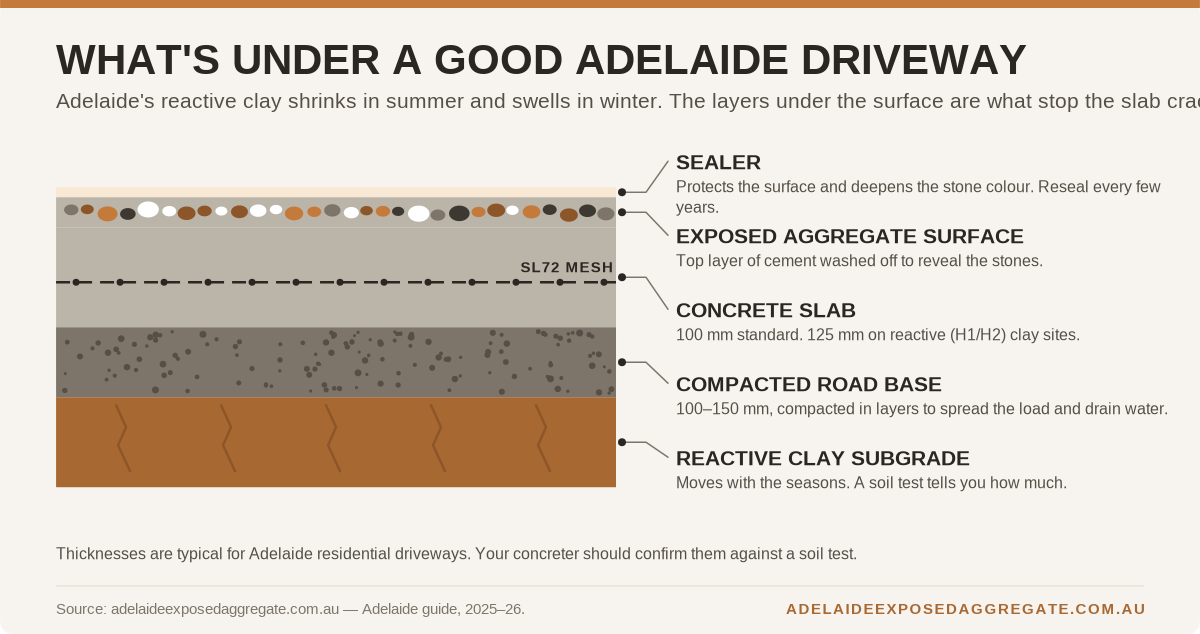
What does reactive clay do to concrete?
Reactive clay lifts and drops a slab unevenly, and the slab cracks where it cannot bend. Clay soils absorb water and expand, then dry out and shrink. In Adelaide, this cycle happens every year — wet winters followed by dry summers create significant ground movement.
A concrete slab sitting on reactive clay experiences different pressures across its area. One edge might lift while another stays put. The result is cracking, edge curl and uneven surfaces.
Which soil class is your Adelaide suburb?
Most Adelaide suburbs are Class M to H2, and the class can change from one street to the next. The table gives the usual pattern.
A soil test (about $300–$500) tells you the exact class for your property. Without it, a concreter has to guess — and guessing on reactive clay leads to cracks.
Published SA guidance adds some local detail: significant H1 and H2 clay in northern suburbs such as Elizabeth and Parafield, widespread M and H1 in southern suburbs such as Morphett Vale and Reynella, and filled ground in parts of Pooraka, Para Hills and Brahma Lodge.
| Soil class | Reactivity | Where in Adelaide | What it means for concrete |
|---|---|---|---|
| Class M | Moderate | Parts of the plains, some coastal areas | Standard 100 mm slab with SL72 mesh is usually sufficient |
| Class H1 | Highly reactive | Most of the Adelaide metro area | 125 mm thickness, deeper base, closer control joints |
| Class H2 | Very highly reactive | Parts of the Hills face, some inner suburbs | Engineering design usually required — thicker slab, deeper footings |
How do concreters build for Adelaide clay?
Concreters deal with clay by making the slab thicker, stronger and better supported, then telling it where to crack. Each item below should appear on a written quote.
- Deeper compacted base — 100–150 mm of road base, compacted in layers, to spread the load and provide drainage under the slab.
- Thicker concrete — 125 mm instead of the standard 100 mm on H1 and H2 sites.
- N32 grade concrete — stronger than the N25 used in less reactive areas, better crack resistance.
- SL72 or F72 mesh reinforcement — holds the slab together through soil movement.
- Control joints — cut into the slab at regular intervals so any cracking follows a straight, hidden line. Published SA guidance puts driveway joints about 3 m apart.
- Proper curing — Adelaide's dry heat and wind can cause the surface to dry too fast, leading to shrinkage cracks. Curing compound or wet-cure methods prevent this.
How much extra does reactive clay add to a driveway?
Building for H1–H2 clay adds about $10–$25/m² to a driveway, or $400–$1,000 on a typical 40 m² job. The money goes into 25 mm of extra concrete, a deeper base and more joints.
That is small next to the cost of failure. Replacing a cracked 40 m² exposed aggregate driveway means paying $4,425–$8,300 again, plus $30–$60/m² to remove the old slab.
When should you get a soil test?
Get a soil test if your block is on a slope, near a creek or in a suburb with variable soil. The test typically costs $300–$500 and takes a few days.
For a standard residential driveway, most experienced Adelaide concreters know the soil type in your suburb and build to the right standard without a formal test.
Common questions
Will my exposed aggregate driveway crack on Adelaide clay?
All concrete can crack, but proper preparation for your soil class (right thickness, mesh, base and joints) keeps cracks controlled and usually invisible. The risk is much higher when these steps are skipped.
How much does a soil test cost?
A geotechnical soil test in Adelaide typically costs $300–$500. It classifies your soil and tells the concreter exactly what base, thickness and reinforcement to use.
Which Adelaide suburbs have the worst clay?
Suburbs on the Hills face (Burnside, Glen Osmond, Belair) and some inner areas tend to have H1–H2 clay. The plains suburbs are generally Class M. A soil test confirms your specific site.
How thick should a driveway be on reactive clay?
A driveway on Class H1 or H2 reactive clay should be 125 mm thick, compared with 100 mm on Class M soil. It should use N32 concrete and SL72 or F72 mesh over 100–150 mm of compacted road base.
Are pavers better than concrete on reactive clay?
Pavers cope with movement better because they flex instead of cracking, but they can become uneven and may need re-levelling every 5–10 years on reactive clay. See exposed aggregate vs pavers.
Sources
- The Quote Yard: Concreting Services SA (soil classes, specifications and curing)
- What's the Damage: Concreting Cost in Adelaide (prices verified November 2026)
Last reviewed .